Under-desk clearance: the measurements that decide whether you can sit close
Two numbers under the desk decide whether your chair can tuck in at all: the height of the underside and the depth of the legroom. Drawers, cross-braces and power bricks all eat into them, and the loss shows up as a chair that will not go far enough forward.
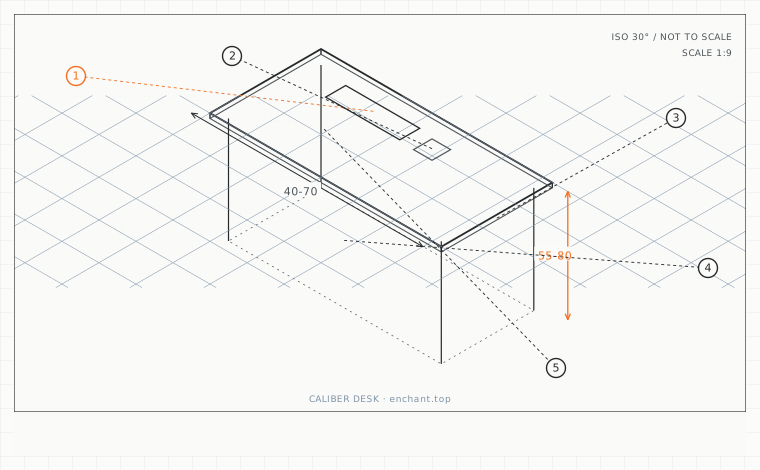
| Callout | Item | Ideal | Band | Why this band |
|---|---|---|---|---|
| 1 | Floor to lowest under-desk obstruction | 65-72 | 62-78 cm | Below 62 cm the thighs contact the underside and the chair loses its range. |
| 2 | Clear width for the chair | 60-70 | 55-80 cm | Under 55 cm the armrests cannot tuck and you sit further back. |
| 3 | Front edge to first obstruction (legroom depth) | 45-60 | 40-70 cm | Sets how far forward the chair can travel before it stops. |
| 4 | Lap desk or coffee table height above seated thigh line | 8-15 | 6-18 cm | The narrow band where neither the neck nor the shoulders take the load. |
| 5 | Depth recovered by relocating a cable basket | 6-10 | 4-14 cm | A free change that often fixes a too-shallow desk. |
The three clearance figures
Height: from the floor to the lowest obstruction under the desktop. Aim for at least 65 cm for a sitting user, measured to the actual obstruction, not the desktop. A 4 cm steel cross-brace at the back turns a 72 cm desk into a 68 cm desk for your knees.
Width: at least 60 cm of clear span for the chair, and 70 cm if you want to move your legs. Depth: at least 45 cm from the front edge back to the first obstruction. These three numbers are what the desk trade calls 'knee space' and they matter more than the desktop area.
Sofa and low-table setups
In a sofa corner there is no undersurface to measure, so the constraint moves to your knees. If your knee top is above the table surface, you cannot get close, and you will compensate by leaning forward and reaching down. Measure the table height against your seated knee height before deciding the setup will work.
The workable range for a lap desk or coffee table is a surface 8-15 cm above your seated thigh line. Lower than that and the neck takes the load; higher and the shoulders do.
Recovering clearance without buying anything
Mount the power strip on the underside or the back leg rather than the floor, and move the cable basket to one side instead of the centre. Together these two changes typically recover 6-10 cm of depth and 4-6 cm of height.
If a centre drawer is the obstruction, check whether it is removable. On most pedestal desks the drawer box is held by four screws and can be taken out in five minutes, which returns the full clearance figure and is reversible if you keep the parts.
Before you measure
- Measure floor to the lowest under-desk obstruction, not to the desktop
- Confirm at least 60 cm of clear width between the legs
- Measure front edge to first obstruction and target 45 cm or more
- Move the power strip and cable basket to recover clearance
- For sofa setups, check the surface is 8-15 cm above the seated thigh line
Once it is measured
- 65 cm minimum height from floor to the lowest obstruction under the desk
- 60 cm clear width for the chair, 70 cm to move your legs
- 45 cm depth from the desk front edge to the first obstruction
- Moving a power strip and a cable basket typically returns 6-10 cm of depth
Three budget bands
Under $25 - adhesive cable clips and an under-desk power strip mount. Recovers 6-10 cm of depth for the cost of a sandwich.
$150-$350 - a desk with a rear-only cable tray and no centre drawer box, so the full knee span is unobstructed.
$800+ - a sit-stand desk with a 4-leg frame, a rear rail, and a published clearance diagram showing the exact knee-space envelope.
Printable spec
Under-desk height 65-72 cm - clear width 60-70 cm - legroom depth 45-60 cm - lap desk 8-15 cm above the seated thigh line
Questions that come up
- Can I raise the desk instead of removing the drawer?
- Only if raising it still leaves the keyboard at the right height. Most often it does not - you trade a knee problem for a shoulder problem. In that order, the shoulder problem is the worse one.
- Is there a minimum clearance for a standing desk?
- Yes, but the binding constraint changes. Standing, you need enough height that the under-desk cable tray does not touch your thighs, which usually means a 90 cm or higher frame setting with 15 cm of clear height beneath.
Adjacent factors
- 2.05Desk height: seat height plus 20 to 25 cm, and why 75 cm fits almost nobody
- 2.05Keyboard height and tilt: the negative-angle trick that saves your wrists
- 2.05Desk depth: the working arc that decides where your monitors can go
- 2.05Mouse plane and arc: matching the mouse height to the keyboard
- 2.05Laptop riser math: how high the stand has to be, calculated not guessed
This page is measurement reference material, not medical advice. It describes dimensions that reduce load on a healthy adult at a desk; it does not diagnose, treat or prevent any condition. If you have an existing back, neck, wrist or circulation problem, or you are pregnant, take the numbers to a clinician or a qualified ergonomist rather than treating them as a prescription. All figures are adult anthropometric approximations - measure your own body before you spend money.