Desk height: seat height plus 20 to 25 cm, and why 75 cm fits almost nobody
The standard desk is 73-75 cm high. That number came from typewriter tables sized for the average of a 1950s male population. If you are under 178 cm, it is probably too tall for you, and the whole reason your shoulders creep up is that your desk is asking them to.
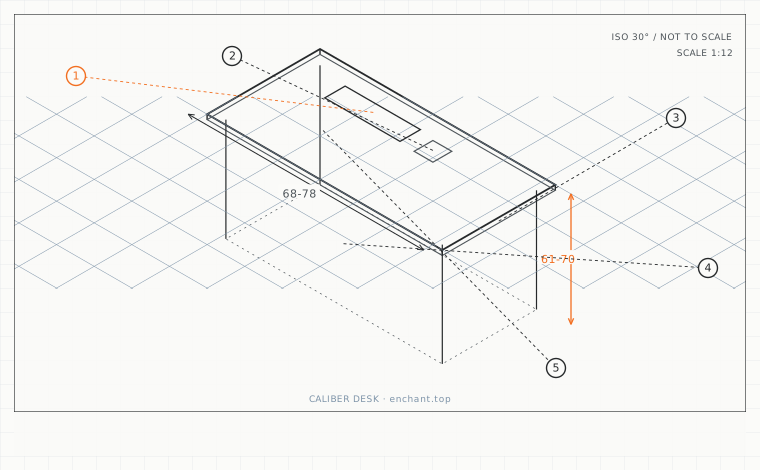
| Callout | Item | Ideal | Band | Why this band |
|---|---|---|---|---|
| 1 | Desk height above the seat surface | 20-25 | 18-28 cm | Puts the elbow at 90-100 degrees with the shoulder relaxed. |
| 2 | Typical floor-to-desktop for a 43 cm seat | 63-68 | 61-70 cm | Why the 75 cm default is 7-10 cm too tall for this group. |
| 3 | Typical floor-to-desktop for a 50 cm seat | 70-75 | 68-78 cm | The narrow band the standard desk was actually designed around. |
| 4 | Keyboard tray drop from desktop | 8-12 | 6-15 cm | Enough to rescue a fixed-height desk without a new one. |
| 5 | Leg clearance under the tray | 65 | 62-72 cm | Below this the tray forces the knees apart or the chair down. |
Derive desk height from the seat, not from the floor
Set the chair correctly first. Then measure from the seat surface to the underside of your forearm at the elbow while your shoulders are relaxed. That distance - typically 20-25 cm - is the desk height above the seat, not above the floor.
Add your seat height and you get your floor-to-desktop number. A person with a 43 cm seat needs a desk at 63-68 cm. A person with a 50 cm seat needs 70-75 cm. The single number 75 fits one of those two people well and the other one badly.
What a too-tall desk actually does
A desk 5 cm too tall raises the shoulders by 5 cm and holds them there. There is no muscle in the shoulder girdle designed to hold a static elevated position for six hours, which is why the tightness shows up in the upper trapezius rather than in the arms.
The second effect is at the wrist. Reaching up to a high keyboard puts the wrist into extension before you have typed anything, and every keystroke adds a few more degrees of bend on top of that.
Fixes, cheapest first
A keyboard tray that clamps under the desktop drops the input surface 8-12 cm and is the standard answer for a fixed-height desk. Choose one with a negative-tilt option and at least 60 cm of width, and check that it leaves 65 cm of leg clearance below it.
Cutting the legs is the permanent fix and is easier than it sounds on a wooden or steel-leg desk: a pipe cutter removes 4 cm in a few minutes. If you cut, cut in 2 cm steps and re-measure - going 5 cm short is unrecoverable, going 2 cm short is another cut.
Before you measure
- Set the chair height first, then measure relaxed elbow height above the seat
- Add the seat height and compare with your desktop's actual height
- If the desk is more than 3 cm too tall, fit a keyboard tray
- Confirm 65 cm of leg clearance below the tray
- Re-measure after any change - do not carry numbers over from a previous setup
Once it is measured
- Desk height = seat height + 20-25 cm, measured at the relaxed elbow
- A 75 cm desk fits a 50 cm seat height, not a 43 cm one
- A too-tall desk raises the shoulders and pre-bends the wrist
- Keyboard tray first, leg cutting second, new desk last
Three budget bands
Under $60 - a clamp-on keyboard tray with negative tilt. The single highest-return purchase for a fixed 75 cm desk.
$300-$600 - an electric sit-stand desk with a 62-128 cm height range, so both a short and a tall user can find their number.
$900+ - a desk with four memory presets and a printed height accuracy of plus or minus 1 mm, plus a cable tray that preserves leg clearance.
Printable spec
Desk = seat height + 20-25 cm - 43 cm seat -> 63-68 cm desk - 50 cm seat -> 70-75 cm desk - keyboard tray drops 8-12 cm - keep 65 cm leg clearance
Questions that come up
- Can I just raise my chair instead of lowering the desk?
- Only if your feet still reach the floor flat. Raising the chair lifts the knees with it, and once the feet dangle the seat-height specification is broken. Add a footrest at the same time if you go this route.
- Do standing desks have the same problem?
- They solve it, provided the lowest setting reaches your sitting number. Check the minimum height before you buy: a desk with a 72 cm minimum cannot serve a 43 cm seat height at all.
Adjacent factors
- 2.05Keyboard height and tilt: the negative-angle trick that saves your wrists
- 2.05Desk depth: the working arc that decides where your monitors can go
- 2.05Mouse plane and arc: matching the mouse height to the keyboard
- 2.05Under-desk clearance: the measurements that decide whether you can sit close
- 2.05Laptop riser math: how high the stand has to be, calculated not guessed
This page is measurement reference material, not medical advice. It describes dimensions that reduce load on a healthy adult at a desk; it does not diagnose, treat or prevent any condition. If you have an existing back, neck, wrist or circulation problem, or you are pregnant, take the numbers to a clinician or a qualified ergonomist rather than treating them as a prescription. All figures are adult anthropometric approximations - measure your own body before you spend money.