Seat pan tilt: the 5 degrees that decides whether you fidget or ache
A seat pan that tilts forward 5 degrees opens your hip angle and lets the lumbar curve hold itself. Tilt it back and you get a relaxed recline that needs the backrest to do all the work. The mistake is using one setting for both modes.
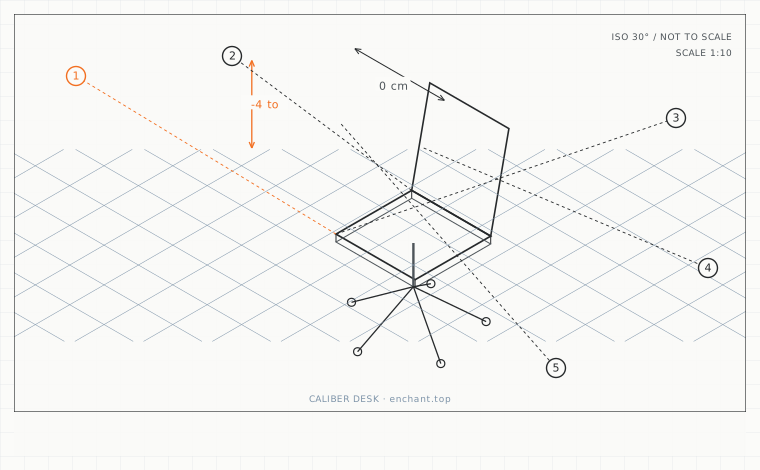
| Callout | Item | Ideal | Band | Why this band |
|---|---|---|---|---|
| 1 | Forward tilt for active work | -5 | -4 to -6 deg | Opens the hip past 90 degrees and restores the lumbar curve without a cushion. |
| 2 | Tilt for reclined work | 0 | 0 to +4 deg | Prevents shear across the sacrum when the backrest is past 110 degrees. |
| 3 | Joint change when you switch mode | 5 | 4-8 deg | Small enough to set by feel, large enough to feel within a minute. |
| 4 | Pressure-relief window before repositioning | 20-30 | 15-40 min | A forward tilt buys you time; it does not remove the need to move. |
| 5 | Tilt-adjustment step size | 2 | 1-3 deg | Bigger jumps overshoot and send you back to the wrong setting. |
Forward tilt is for active work
Set the pan to minus 4 to minus 6 degrees - front edge lower than the back - when you are typing, reading closely, or alternating between sitting and standing. Opening the hip past 90 degrees rotates the pelvis forward and restores the lumbar curve without any cushion.
The catch is that a forward tilt puts more weight on the feet and the ischial tuberosities. That is why it works best on a sit-stand chair used in short blocks, and badly on a chair you intend to sit in for four hours.
Backward tilt is for reclined work
Set the pan to 0 or up to plus 4 degrees when you recline past 110 degrees for calls or reading on screen. Combining a forward-tilted pan with a reclined backrest creates a shear force across the sacrum - the single most reliable way to produce lower-back discomfort from an ergonomic chair.
Pair any recline beyond 110 degrees with the pan at neutral. This is also the setting that makes armrests useful, because your forearms can rest without pulling you forward.
Setting it by feel in ten seconds
Sit with feet flat and hands off the desk. If you feel pressure building behind your thighs within a minute, the front edge is too high - flatten the pan. If you feel yourself sliding forward and catching with your feet, the tilt is too steep - reduce it by 2 degrees at a time.
Mark the position. Most tilt levers have no scale, so put a strip of masking tape on the mechanism housing and draw a line at your two settings: one for typing, one for calls. Two marked positions beat a continuous range you can never return to.
Before you measure
- Set pan to minus 4-6 degrees and type for five minutes
- Check for pressure behind the thighs - none means the setting is right
- Reset pan to neutral before reclining past 110 degrees
- Mark both positions on the mechanism housing with tape
- Stand up at least every 30 minutes regardless of tilt
Once it is measured
- Minus 4 to minus 6 degrees for active typing and sit-stand alternation
- Neutral or up to plus 4 degrees whenever you recline past 110 degrees
- Never combine a forward tilt with a deep recline - that is the shear-force combination
- Tape and mark your two working positions on the mechanism
Three budget bands
Under $20 - a wedge cushion that gives a fixed 5-degree forward tilt. Non-adjustable, but it proves whether the setting suits you.
$250-$500 - a mechanism with a tilt lever that holds its position under load, not one that slips back after a week.
$800+ - a synchronised tilt mechanism where the pan tilt and backrest angle move together on a fixed ratio, set once by a single tension dial.
Printable spec
Active work: pan at -5 deg - Reclined work: pan at 0 to +4 deg - Never forward tilt with a recline past 110 deg - Stand up every 30 min
Questions that come up
- My chair tilts backward with my legs - is that the same thing?
- No. That is a rocking mechanism, which changes the whole chair's angle. Pan tilt changes only the seat surface relative to the backrest, and the two are adjusted separately on a properly equipped chair.
- Is forward tilt bad for circulation?
- Forward tilt reduces pressure under the thighs but increases it under the ischial tuberosities. That is fine for 20-30 minute blocks and not fine for a full afternoon. Alternate with the neutral setting.
Adjacent factors
- 1.05Seat height: the measurement everything else is built on
- 1.05Seat depth: the measurement that decides whether your back gets support at all
- 1.05Lumbar support height: find it by measuring your belt line, not your waist
- 1.05Armrest height: how high before they start lifting your shoulders
- 1.05Backrest angle and tension: the two settings people never touch
This page is measurement reference material, not medical advice. It describes dimensions that reduce load on a healthy adult at a desk; it does not diagnose, treat or prevent any condition. If you have an existing back, neck, wrist or circulation problem, or you are pregnant, take the numbers to a clinician or a qualified ergonomist rather than treating them as a prescription. All figures are adult anthropometric approximations - measure your own body before you spend money.