Lumbar support height: find it by measuring your belt line, not your waist
Most adjustable lumbar pads are set 5 cm too low, because people aim them at the sensation of 'lower back' rather than at the actual inward curve. Your lumbar apex is a fixed distance above the seat, and it is a number you can measure.
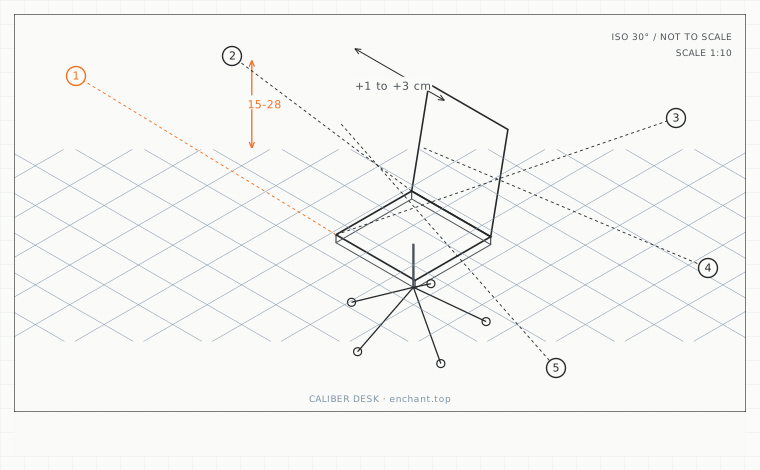
| Callout | Item | Ideal | Band | Why this band |
|---|---|---|---|---|
| 1 | Lumbar apex above seat surface | 18-25 | 15-28 cm | The inward curve is deepest here; support at this height lets the spine hold itself. |
| 2 | Pad offset relative to apex | +1 to +3 | -2 to +5 cm | A slight upward bias avoids pushing the pelvis into a posterior tilt. |
| 3 | Pad thickness under full lean | 2-3 | 1-4 cm | What remains after compression is the only figure that does any work. |
| 4 | Nominal pad thickness (high density) | 4 | 3-6 cm | Enough material to stay firm; more thickness usually means softer foam. |
| 5 | Height adjustment range needed | 10 | 8-14 cm | Covers the difference between a 160 cm and a 190 cm user sharing one chair. |
Locate the apex, not the discomfort
Stand sideways to a mirror and find the deepest point of your lower-back inward curve. Measure from the floor to that point. Now sit down and measure from the floor to the seat surface. Subtract: the difference is your lumbar apex height above the pan, and it is typically 18-25 cm.
The pad should press at that height, with a slight bias upward rather than downward. Aiming the pad at the point that hurts is a reliable way to make it hurt more, because a pad below the apex pushes the pelvis into a posterior tilt.
Small spaces force a compromise
In a compact room you are often sitting closer to the desk than you would like, which shortens the effective seat depth and pushes the lumbar region away from the backrest. The pad then has to travel forward with you - a pad on a fixed backrest simply will not reach.
The practical answer in a small space is a strap-on lumbar pad that sits between you and the backrest rather than being built into it. It moves with your body, keeps contact at a shortened seat depth, and costs a fraction of a new chair.
Firmness matters as much as height
A pad that compresses to under a centimetre of firm support stops working the moment you lean back. Aim for a pad that still provides 2-3 cm of resistance under your full lean. Foam density is the spec that matters, not thickness - a 4 cm high-density pad outperforms an 8 cm soft one.
Set the height first, then the depth of the pad's curve. If you are still adjusting firmness after two weeks, the height is wrong and you are compensating with pressure.
Before you measure
- Stand sideways at a mirror and locate the deepest point of the lumbar curve
- Measure floor to that point, then floor to seat, and subtract
- Set the pad 1-3 cm above that height
- Lean back fully and check the pad still resists by 2-3 cm
- Sit for 20 minutes and confirm no new pressure point appears
Once it is measured
- Lumbar apex sits 18-25 cm above the seat surface, measured when seated
- Aim slightly above the apex, never below it
- In small rooms use a strap-on pad that moves with you, not a built-in one
- A 4 cm high-density pad beats an 8 cm soft pad
Three budget bands
Under $25 - a strap-on high-density lumbar pad with a height-adjustable strap channel. Works on any chair you already own.
$300-$600 - a chair with a lumbar pad on a ratchet track, so height can be changed without tools.
$900+ - a chair with independently adjustable lumbar height and depth, so the pad can be pushed shallow for forward-tilt work.
Printable spec
Lumbar apex = 18-25 cm above the seat - set the pad 1-3 cm above it - 2-3 cm of firm resistance under full lean
Questions that come up
- Is a lumbar pad necessary if my chair has a curved backrest?
- Only if the backrest curve lands at your apex. A chair backrest has a fixed curve; your apex moves with your height. Measure first - many people find the built-in curve sits 4-6 cm too low and needs a pad on top of it.
- Does a lumbar pad help with slouching?
- It helps you hold a position, but slouching is usually a fatigue signal rather than a support failure. If the pad stops helping after 40 minutes, the answer is a break, not a firmer pad.
Adjacent factors
- 1.05Seat height: the measurement everything else is built on
- 1.05Seat pan tilt: the 5 degrees that decides whether you fidget or ache
- 1.05Seat depth: the measurement that decides whether your back gets support at all
- 1.05Armrest height: how high before they start lifting your shoulders
- 1.05Backrest angle and tension: the two settings people never touch
This page is measurement reference material, not medical advice. It describes dimensions that reduce load on a healthy adult at a desk; it does not diagnose, treat or prevent any condition. If you have an existing back, neck, wrist or circulation problem, or you are pregnant, take the numbers to a clinician or a qualified ergonomist rather than treating them as a prescription. All figures are adult anthropometric approximations - measure your own body before you spend money.