Seat height: the measurement everything else is built on
Seat height sets your knees, and your knees set your shoulders. Get this one number wrong by 4 cm and you will spend the rest of the day compensating with your neck. Here is how to measure it with a tape measure and a wall, not a catalogue.
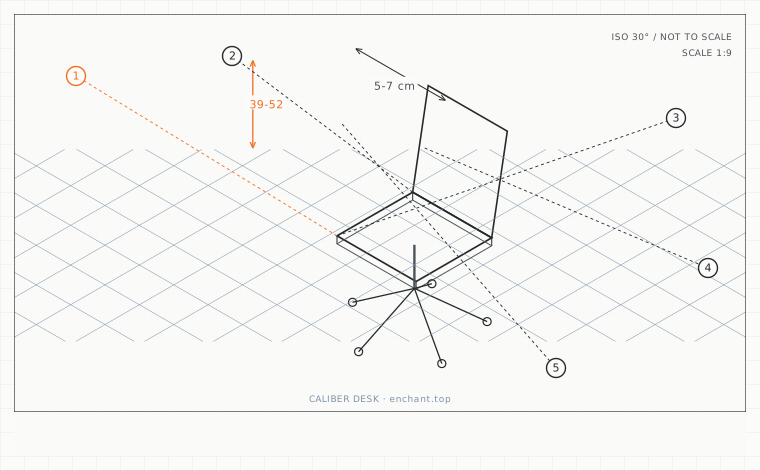
| Callout | Item | Ideal | Band | Why this band |
|---|---|---|---|---|
| 1 | Seat height (floor to seat top) | = popliteal height | 39-52 cm | Feet stay flat and thighs stay horizontal, which keeps the hip angle open. |
| 2 | Gap behind the knee | 5-7 | 3-10 cm | Clears the popliteal artery and vein; below 3 cm the edge presses into the nerve bundle. |
| 3 | Finger clearance under the front edge | 2 (finger width) | light contact cm | The fastest field check for a seat that is 2-4 cm too high. |
| 4 | Seat cushion thickness (if used) | 3-5 | 2-6 cm | Enough to lift a tall user onto a fixed desk without collapsing into the seat pan. |
| 5 | Minimum desk height needed | = seat height + 20 | 62-73 cm | If your desk cannot go this low, the chair cannot be set correctly. |
Measure your popliteal height first
Sit on any hard chair with your feet flat and your knees bent to roughly a right angle. Measure from the floor to the crease behind your knee - the popliteal crease. That distance, not your overall height, is the seat height you need.
Adult popliteal height lands between 39 cm and 52 cm for the large majority of people. A 170 cm person typically measures 43-45 cm; a 185 cm person typically measures 47-50 cm. If your chair is set at the 48 cm factory default and you measure 43 cm, your feet will dangle and your thighs will take the pressure.
The two-finger test for the front edge
Once the seat is at popliteal height, slide two fingers horizontally under the front edge of the seat. They should pass with light contact. If they are pinched, the seat is too high and is cutting off circulation behind the knee. If they pass with a gap of more than about 3 cm, the seat is too low and your hip angle is closing past 90 degrees.
Desk-bound laptop users are the group that gets this wrong most often, because laptop stands and monitor arms change the eye level and tempt people to raise the chair instead of lowering the desk. Raise the chair only if the desk cannot move; otherwise move the desk.
What to do when the numbers disagree
If your measured popliteal height is below your desk's minimum height, you have a desk problem, not a chair problem. Two fixes work: a footrest that brings the floor up to your feet, or cutting the desk legs down. A footrest is reversible and costs less than a new desk; choose one whose top sits at popliteal height minus 0 cm, and put your feet flat rather than on the rungs.
If your popliteal height is above the desk's maximum, add a 3-5 cm seat cushion. That is a legitimate fix, not a workaround: cushions raise the effective seat height and are the standard answer for tall users on fixed-leg desks.
Before you measure
- Sit on a hard chair, feet flat, and measure floor to the crease behind the knee
- Set the chair so the seat top equals that measurement
- Slide two fingers under the front edge; they should pass with light contact
- Check the knee gap is at least 3 cm with both feet flat
- If the desk cannot reach seat height + 20 cm, add a footrest or a cushion
Once it is measured
- Seat height = your popliteal height, measured floor to the crease behind the knee
- Most adults measure between 39 cm and 52 cm, so a fixed 48 cm chair fits a minority
- Two fingers should slide under the front edge with light contact
- Fix a mismatched desk with a footrest or a cushion before buying a new chair
Three budget bands
Under $40 - a 10 cm wooden footrest with two height positions, and a tape measure. Fixes the majority of fixed-desk mismatches.
$120-$300 - a gas-lift chair with a documented seat-height range printed on the spec sheet, not just 'adjustable'.
$500+ - a chair with independent seat-height and seat-depth adjustment plus a seat-slide lock, so the two numbers stop fighting.
Printable spec
Seat top = popliteal height (39-52 cm) - knee gap 5-7 cm - two fingers under the front edge - desk at seat height + 20 cm
Questions that come up
- My chair's gas lift sinks during the day. Is that a height problem?
- Yes, and it is the most common cause of a correct measurement drifting wrong. A Class 4 gas lift should hold within 1 cm over a working day. If it drops more, the cylinder is failing and no amount of re-measuring will help.
- Should I set seat height with shoes on?
- Measure barefoot if you work barefoot or in socks. If you always wear the same indoor shoes, measure with them on and keep the number for that pair - a 2 cm sole is 2 cm of seat height.
Adjacent factors
- 1.05Seat pan tilt: the 5 degrees that decides whether you fidget or ache
- 1.05Seat depth: the measurement that decides whether your back gets support at all
- 1.05Lumbar support height: find it by measuring your belt line, not your waist
- 1.05Armrest height: how high before they start lifting your shoulders
- 1.05Backrest angle and tension: the two settings people never touch
This page is measurement reference material, not medical advice. It describes dimensions that reduce load on a healthy adult at a desk; it does not diagnose, treat or prevent any condition. If you have an existing back, neck, wrist or circulation problem, or you are pregnant, take the numbers to a clinician or a qualified ergonomist rather than treating them as a prescription. All figures are adult anthropometric approximations - measure your own body before you spend money.