Sofa-corner screens: when the top of the screen has to be below your eyes
In a sofa or low-table setup the geometry inverts. You are reclined, your eye level is lower relative to the desk surface, and the screen often ends up at or above your eye line. This sheet is about measuring that inversion instead of guessing at it.
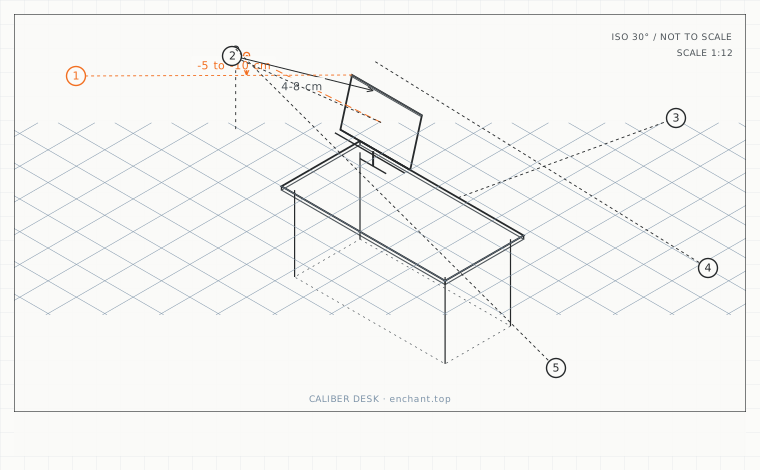
| Callout | Item | Ideal | Band | Why this band |
|---|---|---|---|---|
| 1 | Screen top relative to seated eye level (reclined) | -5 to -10 | -15 to 0 cm | Removes upward gaze, which is the harder direction for the neck. |
| 2 | Sofa cushion compression under load | 4-8 | 2-12 cm | Explains why a sofa setup changes height during a session. |
| 3 | Acceptable eye-level drop over 20 minutes | 0-2 | 0-4 cm | More than this means the seat is too soft for sustained work. |
| 4 | Lap desk height gain | 8-12 | 6-15 cm | Usually enough to move the screen into the correct band. |
| 5 | Position reset interval | 45 | 30-60 min | Cushion drift makes this the least stable setup of all. |
Measure from the cushion, not the floor
Sofa cushions compress 4-8 cm and the compression changes as you shift. Measure the seated eye level from the floor while sitting in your normal working position, with your laptop or screen already placed. Repeat after twenty minutes - if the eye level has dropped more than 2 cm, your support is too soft for sustained work.
Then measure the screen top. In a sofa corner the shortfall is usually negative: the screen top sits 10-25 cm above your eye line, and you look up. Sustained upward gaze is harder on the neck than downward gaze because the neck extensors have to hold the head against gravity.
Fix the inversion with a lap desk or a stand
A lap desk raises the surface by 8-12 cm and moves it forward, which brings the screen into the correct band. Choose one with a rigid top rather than a bean-filled cushion base, because a soft base tilts as you shift and your screen height drifts with it.
If you use a floor stand or a coffee-table riser, aim for the screen top 5-10 cm below eye level in your reclined position. That number is smaller than the seated figure, because reclining already flattens your line of sight.
Distance and the 45-minute rule
Sofa work is usually done for shorter blocks, and the correct distance is the same as any other setup - 55-70 cm for a 27-inch screen, proportionally less for a laptop. The difference is that in a reclined position it is easy to drift back without noticing, and a 10 cm drift turns a 60 cm distance into 70 cm.
Put a physical marker: a cushion seam, a taped line on the floor, or the front edge of the lap desk. The rule of thumb for a sofa setup is to reset your position every 45 minutes, because cushion compression and drift make this the setup that changes most over a session.
Before you measure
- Sit in your real working position and measure eye level from the sofa
- Measure the screen top and note whether the difference is positive or negative
- Add a lap desk or riser to bring the screen top 5-10 cm below eye level
- Re-measure eye level after 20 minutes to check cushion compression
- Set a 45-minute timer to reset your position
Once it is measured
- Measure seated eye level from the sofa, in your real working position
- Sofa cushions compress 4-8 cm; check whether the eye level drops over 20 minutes
- Aim to remove upward gaze: screen top 5-10 cm below eye level in the reclined position
- Reset your position every 45 minutes - sofa setups drift the most
Three budget bands
Under $40 - a rigid-top lap desk. The single most effective change in a sofa setup, and it works on a bed too.
$90-$200 - a floor-standing adjustable screen or laptop stand with a 30 cm height range and a weighted base.
$400-$900 - a proper small desk plus an ergonomic chair placed in the room the sofa is in, removing the sofa-corner compromise entirely.
Printable spec
Reclined screen top 5-10 cm below eye level - cushion compression 4-8 cm - lap desk lifts 8-12 cm - reset position every 45 min
Questions that come up
- Is working from a sofa actually bad?
- It is worse than a desk and better than nothing. The two problems are unstable height and upward gaze, and both are fixable with a rigid lap desk and a measured screen height. The ongoing issue is that cushion compression means your settings drift within a session.
- Should I use a floor stand instead of a lap desk?
- A floor stand if your screen is heavy or you use a separate monitor; a lap desk if you are on a laptop. A floor stand has the advantage of not moving when you shift, which removes the drift problem entirely.
Adjacent factors
- 3.05Monitor height: the top bezel is the number, and it goes below eye level
- 3.05Viewing distance: arm's length is a myth, here is the actual arithmetic
- 3.05Monitor tilt and glare: stop tilting the screen back to beat reflections
- 3.05Screen size and pixel density: picking the diagonal from your viewing distance
- 3.05Dual-screen angles: the fold, the seam, and the neutral head position
This page is measurement reference material, not medical advice. It describes dimensions that reduce load on a healthy adult at a desk; it does not diagnose, treat or prevent any condition. If you have an existing back, neck, wrist or circulation problem, or you are pregnant, take the numbers to a clinician or a qualified ergonomist rather than treating them as a prescription. All figures are adult anthropometric approximations - measure your own body before you spend money.