Standing desk height: elbow height, not a range from a chart
Standing desk height is your standing elbow height, measured, and it varies by 25-30 cm across the adult population. Every published chart gives you a range that is 15 cm wide and you still have to measure inside it. So measure first and use the chart only as a sanity check.
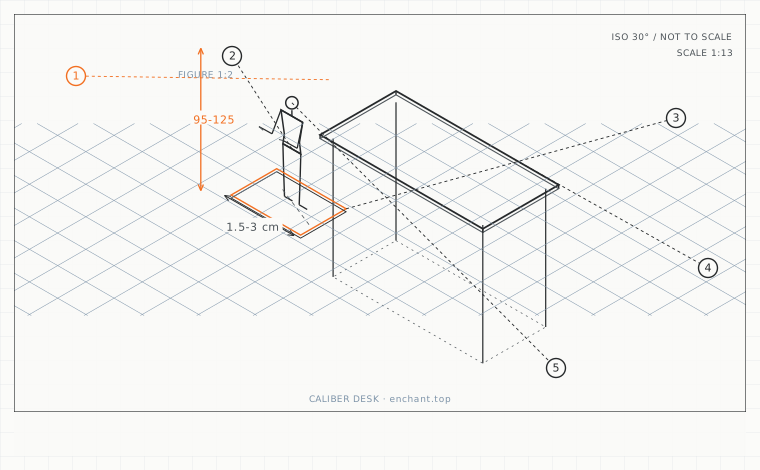
| Callout | Item | Ideal | Band | Why this band |
|---|---|---|---|---|
| 1 | Standing desk height (floor to desktop) | = standing elbow height | 95-125 cm | Puts the elbow at 90-110 degrees with the shoulders relaxed. |
| 2 | Standing elbow angle | 100 | 90-110 deg | The same range as sitting; standing does not change the geometry of the arm. |
| 3 | Working footwear sole height | 2-3 | 0-5 cm | Shifts the correct standing height by the same amount. |
| 4 | Anti-fatigue mat effective height gain | 1.5-3 | 1-4 cm | A 3 cm mat compresses about 30 percent under a standing load. |
| 5 | Tolerance before fatigue appears | +-2 | 0-5 cm | A 5 cm error produces shoulder and lower-back fatigue within 40 minutes. |
Measure your standing elbow height
Stand with your shoes on - the ones you actually wear at the desk - and let your arms hang. Measure from the floor to the crease at the back of the elbow. That is your standing desk height, and it typically lands between 95 cm and 125 cm.
The check is the elbow angle: with your hands on the keyboard, the elbow should be at 90-110 degrees, the same range as sitting. If you are below 90 standing, the desk is too high, and reaching up to a high keyboard while standing is more tiring than doing it seated because your legs are also working.
Why fixed 'standing heights' fail
A desk set to 110 cm suits a person with a 110 cm standing elbow height and forces everyone else into a compromise. At 110 cm, someone whose elbow height is 98 cm works with the keyboard 12 cm above elbow level, which raises the shoulders exactly as a too-tall fixed desk does when sitting.
The most common error is setting standing height too high, because a high desk feels more 'active'. A standing desk that is 5 cm too tall produces shoulder and lower-back fatigue within 40 minutes, which is why people conclude standing desks do not work for them.
Shoes, mats and flooring change the number
Measure the height of your normal working footwear. A 3 cm sole raises your standing elbow height by 3 cm, and if you sometimes work in socks, your standing desk height varies by 3 cm depending on the day. For a sit-stand desk with memory presets, set the preset while wearing the shoes you wear most.
An anti-fatigue mat adds 2-4 cm of standing height, and it compresses by about 30 percent under load, so the effective height gain is 1.5-3 cm. Measure the desk height with the mat in place rather than adding the mat afterwards, or you will spend a week re-tuning the preset.
Before you measure
- Put on your normal working shoes and stand relaxed
- Measure floor to the crease at the back of the elbow
- Set the desk to that height and store it as a preset
- Check the elbow angle is 90-110 degrees with hands on the keyboard
- Lay the anti-fatigue mat and re-measure before finalising the preset
Once it is measured
- Standing desk height = floor to the crease at the back of the elbow, shoes on
- Typical range is 95-125 cm, so no single chart value works for everyone
- Keep the standing elbow angle at 90-110 degrees, the same as sitting
- A mat adds 1.5-3 cm of effective height - measure with it in place
Three budget bands
Under $40 - a tape measure and a wall mark at your standing elbow height, plus a 3 cm mat if you stand in socks.
$300-$600 - an electric sit-stand desk with a 62-128 cm range and four memory presets so both positions are one button away.
$900+ - a four-leg sit-stand desk with millimetre height accuracy and a printed height readout, so the preset can be verified rather than trusted.
Printable spec
Standing height = standing elbow height (95-125 cm) - elbow 90-110 deg - shoes on - mat adds 1.5-3 cm effective
Questions that come up
- Why does standing at my desk hurt my back after 20 minutes?
- Almost always because the desk is too high, which makes you lean forward onto the work surface and reverses the lumbar curve. A standing desk that is 5 cm too tall produces this within 20 minutes; the same desk 5 cm lower does not.
- Should I use the desk's pre-set standing height?
- No. Factory presets are set for a 178-180 cm user. Reset them all on the first day using your measured elbow height, and label the buttons so you do not have to remember which is which.
Adjacent factors
This page is measurement reference material, not medical advice. It describes dimensions that reduce load on a healthy adult at a desk; it does not diagnose, treat or prevent any condition. If you have an existing back, neck, wrist or circulation problem, or you are pregnant, take the numbers to a clinician or a qualified ergonomist rather than treating them as a prescription. All figures are adult anthropometric approximations - measure your own body before you spend money.