Sit-stand ratio: how long, how often, and why the total matters less than the switching
The benefit of a sit-stand desk comes from changing position, not from standing more. Studies of workplace movement consistently show that the switching frequency matters more than the standing total, which means a 30-minute standing block is worse than six 5-minute ones.
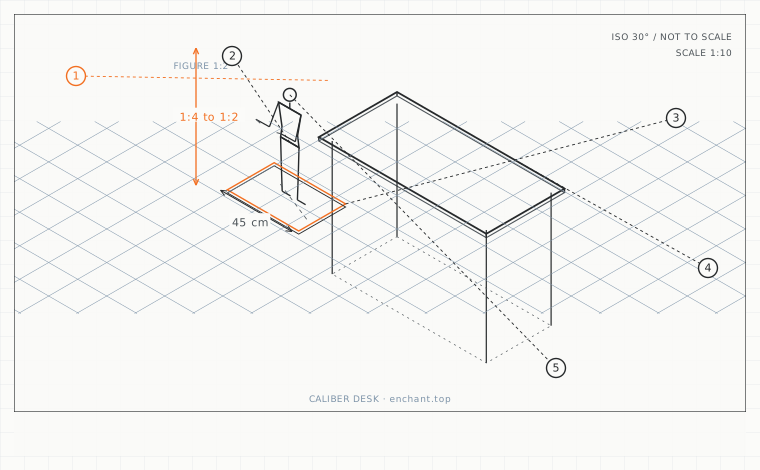
| Callout | Item | Ideal | Band | Why this band |
|---|---|---|---|---|
| 1 | Starting standing-to-sitting ratio | 1:3 | 1:4 to 1:2 ratio | Tolerable on day one without calf and back soreness. |
| 2 | Target ratio after two months | 1:1 | 1:2 to 2:1 ratio | Sustainable for most people with a mat and correct desk height. |
| 3 | Maximum single standing block | 30 | 15-45 min | Beyond this, leg fatigue outweighs the benefit of being upright. |
| 4 | Maximum single sitting block | 45 | 30-60 min | The point at which earlier standing blocks stop paying off. |
| 5 | Target time to change position | 5 | 3-15 sec | Above about 30 seconds, switching frequency collapses. |
Start with 1:3 and build to 1:1
The realistic progression is one minute standing for every three sitting in the first fortnight, moving to 1:1 by the end of the second month. Going straight to 1:1 on day one produces calf and lower-back soreness that makes people abandon the desk entirely within a week.
Measure it rather than estimate it. Set a repeating timer, and log the actual minutes for the first five working days. Most people overestimate how much they stand by a factor of two, and the log is what turns an intention into a ratio you can adjust.
Block length and the upper limit
Keep any single standing block under 30 minutes and any single sitting block under 45 minutes. Beyond 45 minutes seated, the benefits of the standing blocks you did earlier are largely cancelled, which is why the standing total alone predicts very little.
If your work involves long meetings where you cannot move, put the standing block immediately after rather than spreading it. Getting up after an hour of sitting is worth more than a 10-minute stand in the middle of the morning.
Dual screens make switching more expensive
Every position change requires re-setting the desk, and on a dual-screen setup with cable-connected panels, that also means checking that the cables have not snagged. If switching costs 40 seconds of fiddling, you will do it twice a day instead of twelve times.
Fix the friction: route all cables through a single tray with 20-25 cm of slack at the desk's highest position, and put the screens on arms that hold their angle. If switching takes under five seconds, the ratio takes care of itself.
Before you measure
- Set a repeating timer for position changes
- Log actual standing minutes for five working days
- Keep every standing block under 30 minutes and every sitting block under 45
- Route cables with 20-25 cm of slack at the highest desk position
- Time yourself changing position once - it should take under five seconds
Once it is measured
- Build from 1:3 standing-to-sitting in week one to 1:1 after two months
- No standing block over 30 minutes and no sitting block over 45 minutes
- Log actual minutes for five days - people overestimate standing by about 2x
- Make switching take under five seconds or you will not do it
Three budget bands
Under $20 - a repeating timer app and a paper log for five days. The measurement is the intervention.
$300-$600 - a sit-stand desk with a single-button preset for each position and no cable snag at full height.
$800+ - a desk with a companion app that prompts position changes and logs the actual ratio over the week.
Printable spec
Start 1:3, build to 1:1 over two months - standing block max 30 min - sitting block max 45 min - switching under 5 sec
Questions that come up
- Is standing all day better than sitting all day?
- No. Prolonged standing has its own problems, particularly lower-limb and venous issues, and the evidence for standing desks is about interrupting sitting, not about replacing it. The ratio matters; the total does not.
- My desk has only two presets. Is that enough?
- Yes - one sitting and one standing is exactly what you need. The mistake is using both presets for standing heights and leaving the sitting position to be adjusted manually, which makes switching expensive and rare.
Adjacent factors
This page is measurement reference material, not medical advice. It describes dimensions that reduce load on a healthy adult at a desk; it does not diagnose, treat or prevent any condition. If you have an existing back, neck, wrist or circulation problem, or you are pregnant, take the numbers to a clinician or a qualified ergonomist rather than treating them as a prescription. All figures are adult anthropometric approximations - measure your own body before you spend money.