Sofa-corner setup: a measured build instead of a compromise
The sofa corner is usually the setup people apologise for. Treated as a real workstation with its own numbers, it can be made to work for a few hours a day - and it is measured differently from a desk, because almost every reference point moves.
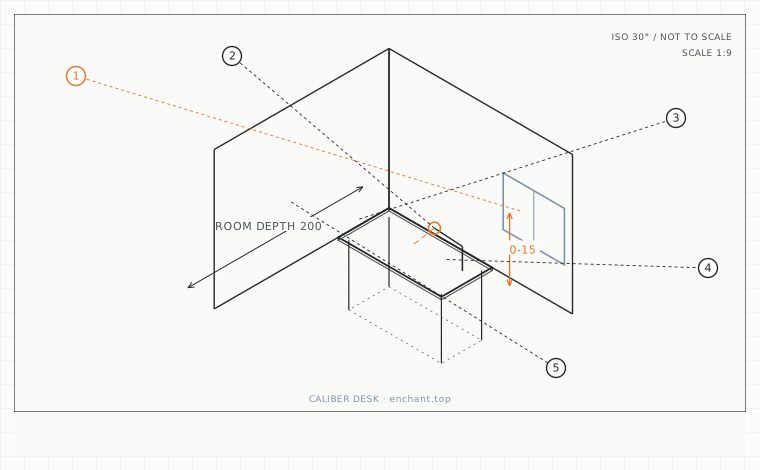
| Callout | Item | Ideal | Band | Why this band |
|---|---|---|---|---|
| 1 | Screen top below seated eye level (reclined) | 5-10 | 0-15 cm | The reclined position flattens the gaze, so the offset is smaller than at a desk. |
| 2 | Chest-to-screen horizontal distance | 50-65 | 45-75 cm | Measured from the chest, not the eyes, because the torso is reclined. |
| 3 | Lap desk surface above the seated thigh line | 8-15 | 6-18 cm | Lower loads the neck; higher loads the shoulders. |
| 4 | Lumbar cushion height above the seat | 18-25 | 15-28 cm | Sofa backrests provide no support at this height on their own. |
| 5 | Practical working ceiling in a sofa setup | 3 | 2-4 h | Beyond this, cushion compression and the missing seat pan outweigh the geometry. |
The three reference points that change
On a desk, the seat height is fixed and the desk height is known. On a sofa, the seat compresses, the surface is a lap desk you place yourself, and your torso is reclined. Measure all three in your working position: seated eye level, lap desk surface height, and the horizontal distance from your chest to the screen.
The target figures for a sofa build are: screen top 5-10 cm below seated eye level, screen 50-65 cm from your eyes, and a lap desk surface 8-15 cm above your seated thigh line. If those three are inside range, the setup works; if not, adjust the lap desk first, since it moves all three at once.
Support the lower back against the sofa
Sofa backrests are typically reclined 15-25 degrees more than a working chair and have no lumbar support at the height you need. Add a firm cushion at your lumbar apex height (18-25 cm above the seat) and sit forward of the sofa's own backrest rather than against it.
Measure your hip angle: with a laptop on a lap desk in a sofa, the angle between thigh and torso is commonly 100-115 degrees, which is more open than a desk chair and actually preferable. The problem is not the angle, it is that nothing holds it, so the muscles work continuously.
The 3-hour rule and what to do after it
A well-built sofa setup is comfortable for about 3 hours of concentrated work. Beyond that, the lack of a proper seat pan and the accumulated cushion compression outweigh the good geometry. If your work requires longer, the sofa is not the right location.
Plan the transition rather than discovering it: set a 45-minute reset timer and a 3-hour ceiling, after which you move to a table. Two 3-hour blocks with a proper break between them is a realistic daily pattern for a sofa-based setup.
Before you measure
- Sit in your working position and measure seated eye level from the floor
- Measure the lap desk surface height and confirm it is 8-15 cm above the thigh line
- Add a firm cushion at 18-25 cm above the seat and sit forward of the backrest
- Measure chest-to-screen distance and bring it to 50-65 cm
- Set a 45-minute reset timer and a 3-hour ceiling
Once it is measured
- Measure seated eye level, lap desk height and chest-to-screen distance in position
- Screen top 5-10 cm below eye level, 50-65 cm away, lap desk 8-15 cm above the thigh line
- Add a firm lumbar cushion at 18-25 cm above the seat and sit forward of the backrest
- Three hours is the practical ceiling for a sofa setup; reset every 45 minutes
Three budget bands
Under $60 - a rigid-top lap desk and a firm lumbar cushion. Between them they convert a sofa corner into a measurable workstation.
$150-$320 - a lap desk with an adjustable tilt and a built-in document ledge, plus a floor lamp at 4000K positioned to the side.
$500-$900 - a small desk and an ergonomic chair placed in the same room, so the sofa is used for short work only and no compromise is needed for the long blocks.
Printable spec
Screen top 5-10 cm below eye level - chest to screen 50-65 cm - lap desk 8-15 cm above the thigh line - lumbar cushion at 18-25 cm - 3-hour ceiling, 45-minute resets
Questions that come up
- Is a recliner better than a sofa for this?
- For the torso, yes - a recliner is designed to hold a reclined position and a sofa is not. But a recliner makes the keyboard position harder, because the arms are further back. Most people do better with a sofa and a lap desk than a recliner and a tray.
- Can I use a monitor on an arm from the sofa?
- Only with a floor stand or a long-reach wall arm. A desk-clamp arm will not span the distance, and a laptop arm clamped to a side table moves every time the table does. A floor stand with a weighted base is the stable option.
Adjacent factors
This page is measurement reference material, not medical advice. It describes dimensions that reduce load on a healthy adult at a desk; it does not diagnose, treat or prevent any condition. If you have an existing back, neck, wrist or circulation problem, or you are pregnant, take the numbers to a clinician or a qualified ergonomist rather than treating them as a prescription. All figures are adult anthropometric approximations - measure your own body before you spend money.