Small-room desk rotation: measuring which wall the desk should face
In a small room you usually have one desk and four walls, and the layout is decided by where the furniture fits rather than where it works. Three measurements - window position, door swing and chair travel - decide the correct orientation before aesthetics get a vote.
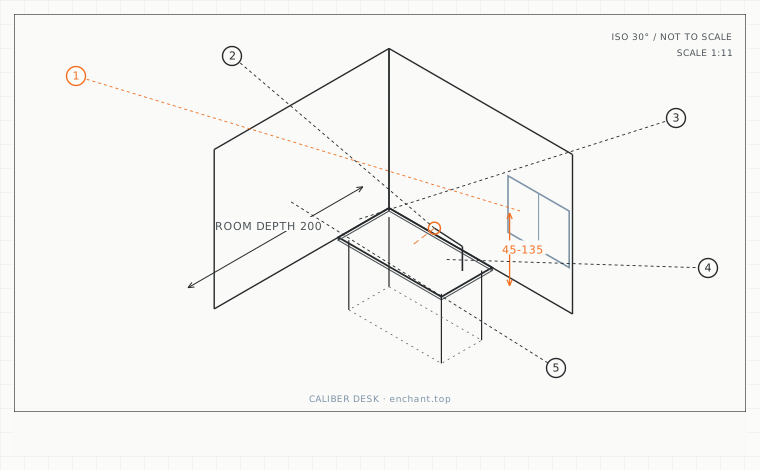
| Callout | Item | Ideal | Band | Why this band |
|---|---|---|---|---|
| 1 | Angle between gaze direction and the window | 60-120 | 45-135 deg | At your side, so the window is neither a glare source nor a reflection. |
| 2 | Chair travel behind the desk front edge | 90-120 | 85-150 cm | Below 85 cm the chair cannot roll back and effective depth shrinks. |
| 3 | Space consumed by a door swing into the chair zone | 0 | 0-80 cm | A door opening into the travel zone removes the space without warning. |
| 4 | Lateral shift to clear a ceiling light reflection | 40-60 | 30-90 cm | Cheaper than any lighting change and usually sufficient on its own. |
| 5 | Radiator temperature effect under a desk | 0 | 0-6 degC | Local warming plus dry air is a real factor across a working day. |
The window rule
Measure the angle between your seated gaze direction and the nearest window. A window in front of you puts the screen between your eyes and a bright surface, which makes the screen look dim and forces your pupils to work against the ambient light. A window directly behind you puts your own reflection on the screen.
The correct answer is a window 60-120 degrees off your gaze direction - at your side, roughly perpendicular. In a room 3 metres wide with one window, that usually means the desk faces a side wall rather than the window wall, which is counter-intuitive but measurable.
Chair travel and the door
Measure from the desk front edge to the nearest obstruction behind the chair. Below 90 cm you lose effective seat depth because the chair cannot roll back. Measure the door swing as well: a door that opens into the chair's travel zone removes 60-80 cm of usable space and you will not notice until someone walks in.
In a room under 2.5 by 2.5 metres, the practical layout is usually a desk on the long wall with the chair travel along that wall rather than into the room. That gives you 20-40 cm more usable travel than facing across the short dimension.
Height and the radiator, the shelves and the light
Check whether anything is mounted on the wall you plan to face: a radiator, a shelf, a wall light. A radiator under the desk raises the local temperature by 3-6 degrees and dries the air, which is a real factor over a working day. A shelf above the desk caps your monitor height at whatever it allows.
Finally, measure the ceiling light position relative to the desk. A ceiling light directly above the desk puts a bright reflection at the centre of a horizontal surface, which is where a document holder sits. Moving the desk 60 cm sideways often fixes it entirely.
Before you measure
- Measure the angle from your seated gaze to the nearest window
- Rotate the desk until the window is 60-120 degrees off your gaze
- Check there is 90 cm of chair travel behind the desk front edge
- Check the door swing does not enter the chair's travel zone
- Check for a radiator, shelf and ceiling light on the wall you face
Once it is measured
- Put the window 60-120 degrees off your gaze direction, at your side
- Keep 90 cm of chair travel behind the desk front edge
- Check the door swing does not enter the chair's travel zone
- Check for radiators, shelves and ceiling lights on the wall you plan to face
Three budget bands
Under $20 - a tape measure and a chalk mark on the floor for the chair's travel. Most small-room layouts are fixed by moving the desk 60 cm.
$60-$150 - a blackout roller blind or a translucent diffuser panel for the window, which allows a layout the room could not otherwise take.
$250-$600 - a corner desk with a 120-degree return, which uses the corner and keeps the chair travel in the long dimension of a narrow room.
Printable spec
Window 60-120 deg off gaze - chair travel 90-120 cm - door swing out of the travel zone - ceiling light not directly overhead - no radiator under the desk
Questions that come up
- My only window is directly in front of the desk. What can I do?
- A translucent blind that still passes light but removes the direct view of the sky is the standard fix. The problem is the luminance difference between the window and the screen, not daylight itself, so diffuse the window rather than blocking it.
- Does facing a wall feel claustrophobic enough to matter?
- It is a real effect for some people. If it is a problem, face the long wall so that your peripheral vision includes the room rather than a wall 80 cm away, and put something with depth at eye level in front of you - a shelf, a plant, a poster with perspective.
Adjacent factors
This page is measurement reference material, not medical advice. It describes dimensions that reduce load on a healthy adult at a desk; it does not diagnose, treat or prevent any condition. If you have an existing back, neck, wrist or circulation problem, or you are pregnant, take the numbers to a clinician or a qualified ergonomist rather than treating them as a prescription. All figures are adult anthropometric approximations - measure your own body before you spend money.