Wrist rest and neutral wrist: measuring the angle you actually type at
Neutral wrist means neither bent up nor bent down, and neither pushed sideways. It is measurable, it is usually 5-15 degrees away from what people actually do, and a wrist rest is only the right answer for about half of them.
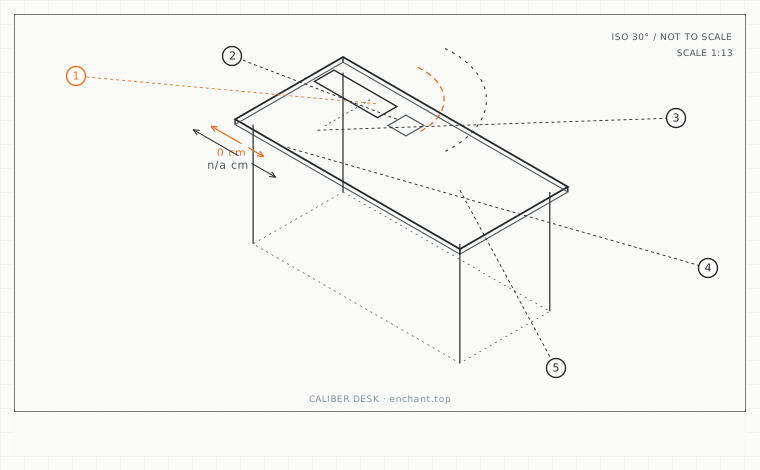
| Callout | Item | Ideal | Band | Why this band |
|---|---|---|---|---|
| 1 | Wrist extension/flexion from the side | 0 | -10 to +10 deg | Neutral is the position with the least pressure inside the carpal tunnel. |
| 2 | Extension produced by a flat keyboard | n/a | 10-20 deg | The baseline you are correcting with negative tilt. |
| 3 | Radial/ulnar deviation from above | 0 | -10 to +10 deg | A narrower tolerance than the side view; ulnar deviation is the more common fault. |
| 4 | Wrist rest depth | 8-10 | 6-14 cm | Enough to land the palm without resting the wrist while typing. |
| 5 | Wrist rest height at the front edge | 1.5-2 | 1-2.5 cm | Higher than 2 cm lifts the hand and reintroduces extension. |
Measure the wrist in two planes
From the side, look at the line of the forearm and the line of the back of the hand. The angle between them is wrist extension when the hand bends up and flexion when it bends down. Neutral is 0 degrees, and a working range of minus 10 to plus 10 degrees is acceptable. Most keyboards set flat produce 10-20 degrees of extension.
From above, look at whether the hand is bent toward the thumb (radial deviation) or toward the little finger (ulnar deviation). Neutral is again 0 degrees and the acceptable range is narrower: plus or minus 10 degrees. Ulnar deviation is the more common of the two and the one most associated with discomfort.
What actually fixes deviation
Ulnar deviation almost always comes from the keyboard being offset from your shoulder, not from the keyboard's shape. Move the keyboard so its centre is in line with the shoulder, not with the middle of the desk. On a standing desk this often means moving the keyboard 10-15 cm toward the side of your dominant hand.
Radial deviation usually comes from the keyboard being too far away, so the hands angle outward to reach the outer keys. Bringing the keyboard 5 cm closer typically removes 8-10 degrees of radial deviation, which is more than any wrist rest will do.
When a wrist rest helps and when it hurts
A wrist rest helps if you work in bursts and need a consistent landing position between them. It hurts if it is positioned so that your wrist is on it while you type, because then it compresses the carpal tunnel continuously and adds a new problem to the one you were solving.
Size it correctly: 8-10 cm deep, 1.5-2 cm high at the front, level with the keyboard's front edge. If it is thicker than 2 cm it lifts the hand and reintroduces extension - the exact angle it was bought to remove.
Before you measure
- Photograph your hands from the side and measure the wrist angle
- Photograph from above and check for radial or ulnar deviation
- Line the keyboard centre up with your shoulder, not the desk centre
- Bring the keyboard 5 cm closer if the hands angle outward
- Set the wrist rest level with the keyboard front, no thicker than 2 cm
Once it is measured
- Neutral wrist is 0 degrees in both planes, with plus or minus 10 acceptable
- Ulnar deviation comes from keyboard offset, not keyboard shape
- Radial deviation comes from the keyboard being too far away
- A wrist rest is 8-10 cm deep, 1.5-2 cm high, level with the keyboard front
Three budget bands
Under $20 - a 2 cm gel wrist rest and a phone camera. Correct the keyboard position first; the rest is optional.
$150-$350 - a split keyboard with tenting, which removes ulnar deviation at the source rather than padding the symptom.
$600+ - a sit-stand setup with an independently adjustable keyboard platform and a palm support that sits below key height.
Printable spec
Wrist 0 deg in both planes (tolerance plus or minus 10) - keyboard centre aligned to the shoulder - wrist rest 8-10 cm deep, 1.5-2 cm high
Questions that come up
- Does a wrist rest prevent carpal tunnel syndrome?
- No. It is a positioning aid, not a medical device, and no desk accessory has been shown to prevent carpal tunnel syndrome. What the research supports is reducing sustained extreme wrist angles, which is what the keyboard position and tilt adjustments do.
- What if my keyboard has a built-in wrist rest?
- Measure its height. Built-in rests are usually 2.5-3.5 cm, which is above the correct figure. Fold a thin cloth over it to bring the effective height down, or use a separate rest and ignore the built-in one.
Adjacent factors
This page is measurement reference material, not medical advice. It describes dimensions that reduce load on a healthy adult at a desk; it does not diagnose, treat or prevent any condition. If you have an existing back, neck, wrist or circulation problem, or you are pregnant, take the numbers to a clinician or a qualified ergonomist rather than treating them as a prescription. All figures are adult anthropometric approximations - measure your own body before you spend money.